
Discover How To Use The Power of Authority Marketing To Make You Money While You Adventure!
No Experience, Existing Product Or Technical Skills Are Required
DO YOU BELIEVE ADVENTURES ARE WORTH CHASING?
We're an affiliate.
We hope you love the products/services we recommend on Just Van Life! So you know, there is the possibility we will collect a commission should you make a purchase via any of our links. This will in no way affect the purchase price. Thank you for your support, we really appreciate it!
There’s nothing worse than being mid vacation only to find that your campervan is getting low on power, meaning you can’t have all your devices running at the same time.
This is a particular problem if you have a fridge in your campervan that you need to keep on in order to keep your food fresh.
And another issue with using gas to power devices in your campervan is of course the environmental impact. It can really drive up your carbon footprint, which isn’t great when there’s so much pressure right now to reduce it.
But luckily there’s an easy solution to both of these issues. If you were to invest in a solar panel or two for your campervan, not only will you have a constant source of power, but you get to enjoy it knowing that it’s not going to harm the environment or unnecessarily use up vital limited resources.
Luckily, there are some really great solar panels for campervans and RVs on the market at the moment. And, after much deliberation, we were able to handpick a shortlist of our top 10 favorites, and our reviews on these are coming up very shortly.
But if you don’t really know what you should look for in a solar panel for a campervan or RV, it can be really tricky to decide which one to get. So for this reason, we have also put together a handy buying guide for you, that will walk you through everything you might want to consider before you buy.
And without further ado, let’s get straight to it!
1 Renogy 200 Watt 12 Volt Monocrystalline Solar Panel Kit
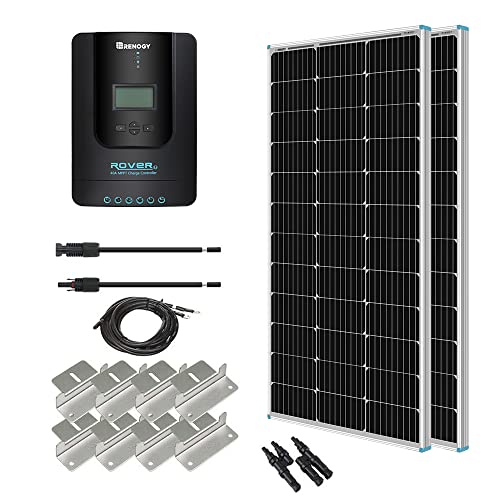
This is easily our favorite campervan solar panel. First off, it has a maximum output of a whopping 200 watts. That’s double the power than what most other such campervan solar panels have to offer.
The solar panel uses monocrystalline cells, which, as we discuss in our buying guide a little later on, makes it far more efficient than its polycrystalline counterparts.
And it comes as an entire kit, rather than just the solar panel alone. In addition to the solar panel, you also get a special controller, all the cables you need, and all the hardware that you need to install the solar panel on the roof of your campervan. All you’ll need to obtain separately is a 12 volt battery.
Installing the solar panel is easy, and there’s a handy video on the product page to demonstrate what you’ll need to do.
Amazon occasionally has deals on this particular solar panel kit, simply click on “check price” to see if there’s a deal on now.
The 200 watt version is a little expensive to buy, but there are also 100 watt versions of the kit that are cheaper.
Pros:
- Offers a whopping 200 watts of power
- Comes as an entire kit with mounting hardware
- Uses monocrystalline cells for high efficiency
Cons:
- Premium product at a premium price

- [Wide Application] 800Wh daily output depends on the 4 hours sunlight availability.This panel is suited for applications that require a smaller footprint, making it a favorite for those with RVs, campers, and more.
- [Excellent Performance] 22% High solar cell efficiency. Corrosion-resistant aluminum frame for outdoor use, allowing the panels to last for decades as well as withstand high winds (2400Pa) and snow loads (5400Pa).
- [Multiple Protection] Renogy ROVER is a 40A MPPT solar charge controller that Automatically detect 12V or 24V DC system voltages Innovative MPPT technology with high tracking efficiency up to 99% and peak Conversion efficiency of 98%. It can prevent the battery from over charge, over voltage, discharge and short circuit, reversed polarity protection.
- [Easy Installation] Pre-drilled holes and Plug&Play cables on the back allow for fast mounting。And it supports 3 types of batteries:lithium batteries, lead-acid batteries, gel batteries.
- [Warranty] 5 year warranty and 24/7 technical support team, contact us through Amazon whatever any questions or concerns you have.
2 BLUETTI SP200 200w Solar Panel
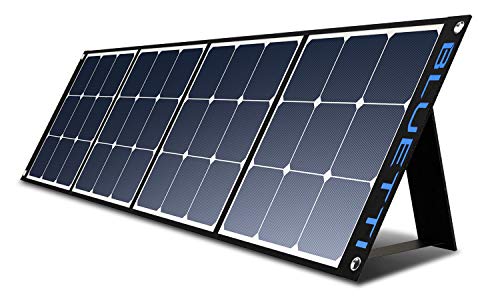
Now, this is a great solar panel! It’s been awarded the title of Amazon’s Choice in the category of camper van solar panels. Such a title is only awarded to products that are both of excellent quality and are available at a good and reasonable price.
Of course, as a very powerful 200 watt solar panel, it’s somewhat more expensive than your regular 100 watt solar panels, however. But that’s not the only thing we love about it…
With this solar panel, you don’t need to worry about the hassle of having to drill into the roof of your campervan to install it. Instead, when you get to the campsite, you simply unfold it, and stand it up somewhere where the sun is shining. It really couldn’t be any easier.
It’s very compact when folded, measuring 20.7 by 20.5 inches, so will easily fit into your campervan when on the road. And it’s relatively lightweight to carry at just 14.3 pounds.
The solar panel uses monocrystalline cells, which, as we discuss in our buying guide a little later on, makes it far more efficient than its polycrystalline counterparts.
Pros:
- Offers a whopping 200 watts of power
- You don’t have to install it to your campervan roof
- Uses monocrystalline cells for high efficiency
- Very lightweight and compact when folded
Cons:
- Only intended for use with a AC200P/EB70/AC50S/EB150/EB240 Bluetti Power Station
- Premium product at a premium price
- [High Conversion Efficiency] - BLUETTI SP200 is a 200-watt monocrystalline solar panel with high conversion efficiency,up to 23.5%, which is much higher than the typical solar panel generator/charger. With excellent 95% transparency, the BLUETTI SP200 performs better than similarly-rated polycrystalline solar panels in low-light conditions,and much higher than the market's average.
- [Durable and Splash-proof] - Made with advanced laminated technology and long-lasting ETFE material on the surface, making it more durable and scratch-resistant. It is IP65 water-resistant that will protect from water splashing (Do not place it under the rain, or to soak in water).
- [Compatible with Most Solar Generators] - BLUETTI SP200 200W foldable solar panel uses MC**4 connector & is designed to be used with most solar generators on the market,including any of the BLUETTI solar generators (AC200MAX/AC200P/EB3A/EB55/EB70S/EB240/AC300/EP500)
- [Foldable & Portable] - With a fold size of 20.7 x 20.5 inches and weight only 14.3lbs, the BLUETTI SP200 is easy to transport and install for anyone.Tips:For best results,we recommend using BLUETTI solar panels with BLUETTI solar generators.We take no responsibility for efficiency to third-party products.
- [What You Get] - 1*BLUETTI SP200 200W solar panel, 1*User Manual
3 Jackery SolarSaga 60W Solar Panel
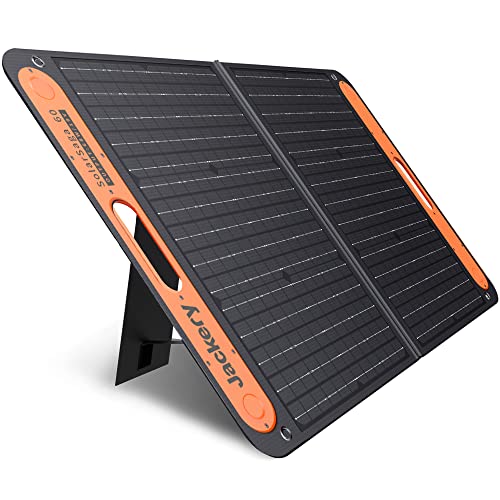
When we saw the customer ratings on this beauty, we just had to see what all the fuss was about – and we weren’t disappointed! Excellent value for money.
This is one of the most portable solar panels you can get, weighing a mere 6.6 pounds. And you don’t need to worry about the hassle of having to drill into the roof of your campervan to install it. Instead, when you get to the campsite, you simply unfold it, and stand it up somewhere where the sun is shining, thanks to the simple stress-free kick-stand set up.
The solar panel uses monocrystalline cells, which, as we discuss in our buying guide a little later on, makes it far more efficient than its polycrystalline counterparts.
It’s equipped with both a USB-C and a USB-A port, so you can use it to charge up to 2 devices at the same time without going through the generator/battery pack to do so.
Pros:
- Particularly lightweight at just 6.6 pounds
- Incredibly easy to set up once you’re settled
- Uses monocrystalline cells for high efficiency
- Equipped with both a USB-C and a USB-A port
- Available at a very affordable price point
Cons:
- Only offers 60 watts of power at the max
- Can only be used with certain Jackery generators

- EASY TO CARRY & KICKSTAND INCLUDED: Weighing at only 6.6 lb, this solar panel is foldable and handy with a TPE rubber handle. The kickstand leans on an angle that makes the solar panel to easily soak energy from the sunlight.
- HIGHER CONVERSION EFFICIENCY: The monocrystalline silicon solar cells provide conversion efficiency of 23%, higher than other conventional panels, allowing your Explorer 160/240 power station(sold separately) to be charged in 4.5hrs/6.5hrs. Ideal for RV camping, off-grid road trip and unexpected power outages.
- DURABLE & SPLASH-PROOF: The ETFE-laminated case is durable enough to extend the lifespan of the solar panel. It is IP65 water-resistant that will protect from water splashing (Do not place it under the rain, or to soak in water). The zippers on the pocket can hold the power cords, and cover the power port.
- COMPATIBLE WITH JACKERY EXPLORERS: It takes 4.5hrs and 6.5hrs to charge Jackery Explorer 160 and Explorer 240 with Solar Saga 60. This portable solar panel is also equipped with 1* USB-C and 1* USB-A port that allows you to charge up to 2 devices at once.
- WHAT YOU GET: 1*Jackery SolarSaga 60 Solar Panel, 1* User Guide.
4 RICH SOLAR 100 Watt 12 Volt Polycrystalline Solar Panel
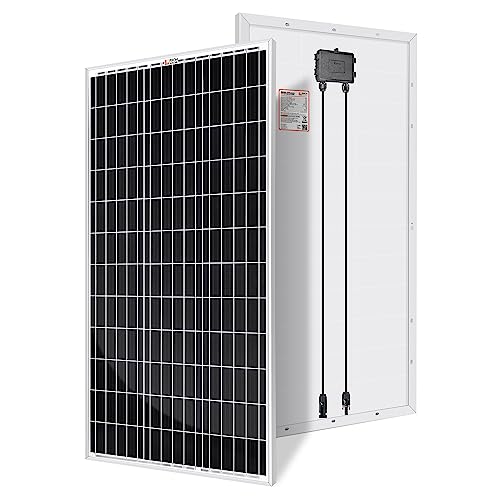
It’s not very often you see a product with a full 5-star average customer rating on Amazon, but Rich Solar has pulled it off.
It can provide up to 100 watts of power on a full charge, which is enough to provide about 400 Watt-hours of power each day (more on this in our buying guide a little later).
It uses polycrystalline solar cells, which goes some way to explaining how it’s so affordable.
And although it doesn’t come with mounting hardware included, there are 14 pre-drilled holes in the frame, and it’s compatible with a range of different mounts, including a tilt mount (more on this in our buying guide, later).
But what really impressed us with this beauty is the warranty. It comes backed by a 25-year limited warranty for power output, and a 5-year warranty for material and workmanship.
Amazon occasionally has deals on this particular solar panel kit, simply click on “check price” to see if there’s a deal on now.
Pros:
- Bargain affordable price tag
- Provides up to 100 watts of power on a full charge
- Comes backed by an impressively long manufacturer’s warranty
Cons:
- It uses polycrystalline cells rather than monocrystalline
- Mounting hardware is not provided, and would have to be bought separately

- 【Standard】 Size: 40.2'' x 20.1'' x 1.2'', 3' cable with connectors, generate 5.15 amp power, charge 12 volt battery. Industry standard, quick connect cables, work in series or in parallel.
- 【Performance】 Excellent low light performance on cloudy days, mornings and evenings. Certified to withstand challenging environmental conditions.
- 【Durable】 Built with strong high transmission anti-reflective coated tempered glass and anodized aluminum frame.
- 【Installation】 Fast and easy installation. 14 pre-drilled holes compatible with ground mounts, Z-brackets, side pole mounts and tilt mounts.
- 【Warranty】 25-year limited power output; 5-year material and workmanship.
5 ACOPOWER 120w 12v Portable Solar Panel

Now, this is a solar panel that really has a lot going for it.
It can provide up to 120 watts of power, which is slightly more than most regular solar panels, which usually tend to offer just 100 watts. And it’s significantly more affordable than the big 200 watt panels that made our shortlist.
It’s a portable panel rather than a fixed or mounted one, so you don’t need to worry about drilling into the roof of your campervan to install it. Instead, when you get to the campsite, you simply unfold it, and stand it up somewhere where the sun is shining, thanks to the simple stress-free kick-stand set up.
The solar panel uses monocrystalline cells, which, as we discuss in our buying guide a little later on, makes it far more efficient than its polycrystalline counterparts.
But what really impressed us with this solar panel kit, is the integrated output box. It has several different ports so you can power several different gadgets at the same time. Moreover, there’s a built-in smart IC chip which maximizes the charging speed while at the same time protecting your devices from overloading and overcharging
Pros:
- Offers a generous 120 watts of power
- Uses monocrystalline cells for high efficiency
- Integrated output box & maximum charging speed
- Does not require being mounted on the roof
- Available at a very reasonable price
Cons:
- Premium product at a premium price

- MADE for SOLAR GENERATORS: ACOPOWER portable solar panels for rv camping compatible with the most solar generators on the market.
- HIGH SOLAR CONVERSION: The Monocrystalline photovoltaic of our backpack solar panels are from the highest conversion efficiency module provider in the world, which increases conversion efficiency up to 25%, which is much higher than the typical solar panel generator/charger.
- DURABLE & SPLASH-PROOF: ACOPOWER 120W folding Solar Panel made of advanced laminated technology and long-lasting ETFE material on the surface, making it more durable, better light transmittance,scratch-resistant, and easy to clean by wet cloth. It is IP65 water-resistant that will protect from water splashing (Do not place it under the rain, or to soak in water).
- EXCELLENT SAFETY: The USB solar panel built-in smart IC chip intelligently identifies your device, and maximizes its charging speed while protecting your devices from overcharging and overloading. The charging current of USB ports (up to 2.4A max 5V DC per port, 6A max overall) is monitored and automatically adjusted according to the sunlight level.
- HIGHLY PORTABLE: Light and portable handle design, three 40W solar panels fold in a suitcase to be 120W folding solar panels, set up in one minute! This camping solar panel is ultra-lightweight of 11.24 lb, ultra-compact of folding size 22.05x17.32x0.79 inch with 56.7x22 inch inch unfolding film surface, two adjustable stands are included in the suitcase. Perfect Charging Pack to Bring Quick Charger Anywhere there is Sun.
6 Topsolar 100W 12V Solar Panel Kit
No products found.As we mention in our buying guide a little later on, one of the best ways to mount a solar panel on the roof of a campervan is at a tilt, in order to give it maximum exposure to direct sunlight. And this solar panel kit comes with a special V shape mount tilt rack bracket, to achieve exactly that. And, better yet, you can adjust the mourning angle as required.
It also comes with a charge controller, all the cables you need, and all the necessary mounting hardware.
And even though it only offers the standard 100 watts of power, the tilted bracket means that it should reach a full charge far more quickly than it’s flat non-titled counterparts.
The solar panel uses monocrystalline cells, which, as we discuss in our buying guide a little later on, makes it far more efficient than its polycrystalline counterparts.
And it also happens to be available at a bargain, affordable price.
Pros:
- Features a special V shape mount tilt rack bracket
- Comes with all the accessories you need
- Can provide up to 100 watts of power
- Uses monocrystalline cells for high efficiency
- It’s available at a bargain, affordable price
Cons:
- This solar panel kit only has an average customer rating of 4 stars on Amazon, whereas all the others in our shortlist have a rating of 4 and a half stars
No products found.
7 Renogy 160 Watt 12 Volt Extremely Flexible Monocrystalline Solar Panel
No products found.Please note, this review is for the 160 watt version of this solar panel, but it’s also available in 50, 100, 175. And 200 watts.
If you have a curved roof on your campervan, don’t worry, you can still mount a solar panel to the roof with one that’s as bendy and flexible as this one. It’s ultra-lightweight, and it can bend up to a whopping 248 degrees, whereas most other flexible solar panels of this nature can only bend to a mere 30 degrees. This way you’re bound to catch some sunlight whether the sun is in front of you or behind you.
The 160 watt version offers more power than your usual 100 watt solar panels. But unfortunately, it usually costs considerably more.
The solar panel uses monocrystalline cells, which, as we discuss in our buying guide a little later on, makes it far more efficient than its polycrystalline counterparts.
You can buy the solar panel alone, or you can buy it as part of a deal together with a compatible battery charger.
Pros:
- Incredibly lightweight and flexible
- Can be installed on a curved campervan roof
- Offers a whopping 160 watts of power
- Uses monocrystalline cells for high efficiency
Cons:
- Premium product at a premium price
No products found.
8 Renogy 100 Watt 12 Volt Monocrystalline Solar Panel

This solar panel comes from one of our favorite brands.
It’s a rigid solar panel that you can fix to the roof of your campervan for maximum sun exposure. You can either buy a single pack or a pack of two, and you can either buy the panel/s alone or together with the brackets, the mount, or even with a dedicated assembly tool.
It offers up to 100 watts of power, which is enough to provide about 400 Watt-hours of power each day (more on this in our buying guide shortly).
The solar panel uses monocrystalline cells, which, as we discuss in our buying guide a little later on, makes it far more efficient than its polycrystalline counterparts.
Amazon occasionally has deals on this particular solar panel kit, simply click on “check price” to see if there’s a deal on now.
Pros:
- Offers up to 100 watts of power
- Uses monocrystalline cells for high efficiency
- Available at a very affordable and reasonable price
Cons:
- Can’t be mounted on a curved campervan roof

- 𝗠𝗮𝗿𝗸𝗲𝘁-𝗟𝗲𝗮𝗱𝗶𝗻𝗴 𝟮𝟱% 𝗖𝗼𝗻𝘃𝗲𝗿𝘀𝗶𝗼𝗻 𝗘𝗳𝗳𝗶𝗰𝗶𝗲𝗻𝗰𝘆 - Renogy's 100w solar panel features A+ grade n-type solar cells, achieving an impressive 25% conversion efficiency. This slolar panel delivers 20W more power output compared to standard solar panels 100 watt of the same design, making it an excellent choice for solar energy solutions.
- 𝟭𝟲𝗕𝗕 𝗧𝗲𝗰𝗵𝗻𝗼𝗹𝗼𝗴𝘆 𝗳𝗼𝗿 𝗘𝗻𝗵𝗮𝗻𝗰𝗲𝗱 𝗣𝗲𝗿𝗳𝗼𝗿𝗺𝗮𝗻𝗰𝗲 - Employing advanced 16BB N-Type solar panel technology, this 100 watt solar panel enhances photoelectric conversion efficiency while minimizing the risk of hot spots and hidden cracks. This results in a longer lifespan and superior performance for your solar panel kit.
- 𝗖𝗼𝗺𝗽𝗮𝗰𝘁 𝗬𝗲𝘁 𝗣𝗼𝘄𝗲𝗿𝗳𝘂𝗹 - Renogy 100w solar panel is 11% smaller and 8% lighter than its predecessor, providing the same power output in a more compact, space-saving design—ideal for tight spaces in Mini Van Life.
- 𝗛𝗶𝗴𝗵 𝗧𝗲𝗺𝗽𝗲𝗿𝗮𝘁?𝗿𝗲 𝗣𝗲𝗿𝗳𝗼𝗿𝗺𝗮𝗻𝗰𝗲 - The Renogy 100 watt solar panel features a low temperature coefficient of -0.29%/℃, which reduces power loss in high temperatures. This characteristic significantly boosts power generation, especially during summer months or in extremely hot climates.
- 𝗕𝘂𝗶𝗹𝘁 𝘁𝗼 𝗟𝗮𝘀𝘁 - With an IP65 rating, this 12v solar panel is designed to endure snow, rain, and heat for decades. The low-iron tempered glass and corrosion-resistant aluminum frame of the renogy solar panels ensure exceptional durability and performance in all weather conditions.
9 Renogy 100 Watt 12 Volt Monocrystalline Solar Panel Kit
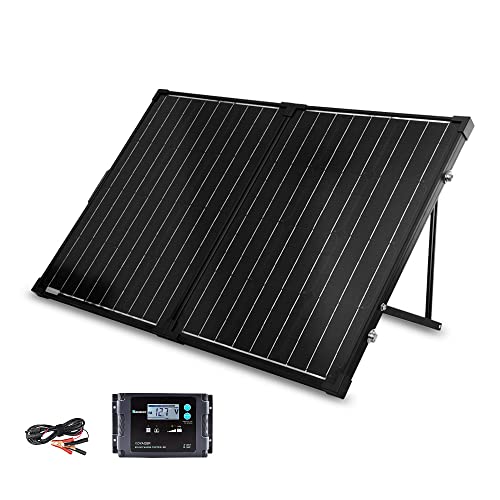
We were very pleased to learn that the Renogy brand also does portable solar panels like this one. They are so much simpler to set up. Rather than having to drill holes in the roof of your campervan, you just put it up outside when you’re ready using the stress-free kickstand.
It can provide up to 100 watts of power on a full charge, which is enough to provide about 400 Watt-hours of power each day (more on this in our buying guide shortly).
It comes complete with a handy charger controller, and it folds right up, so you can carry it like you would a suitcase.
Amazon occasionally has deals on this particular solar panel kit, simply click on “check price” to see if there’s a deal on now.
Pros:
- No need to drill holes in your campervan
- Can provide up to 100 watts of power
- Comes with a handy charger controller
- Can be carried like a suitcase
Cons:
- More expensive than most fixed solar panels
- 【25% High-Efficiency】Powered by N-Type cells boasting up to 25% conversion efficiency, this 100w solar panel delivers exceptional performance even in low-light conditions. The integrated adjustable aluminum alloy kickstand lets you tilt it to the perfect angle toward the sun, maximizing daily energy production (up to 500Wh per day with 5 hours of sunlight). Whether you’re charging devices at a campsite or powering your rv solar panel system, this kit ensures you get the most out of every ray of sunshine.
- 【Compact & Portable Foldable Design for On-the-Go Power】This renogy portable solar panel folds into a sleek, suitcase-sized case (only 17.42 lbs/7.9kg) for easy carrying, storage, and quick setup—perfect for solar panels for camping, RV trips, off-road adventures, or remote cabin getaways. No bulky installation required; unfold, prop up the adjustable kickstand, and start harvesting clean energy wherever your journey takes you.
- 【Plug & Play Ready】Forget complicated wiring—this solar panel kit comes with a pre-installed waterproof 20A PWM charge controller and alligator clip cables, so it’s ready to use right out of the box. The 4-stage charging technology optimizes charging efficiency while extending battery lifespan, compatible with 12V Portable Power Stations, Gel, AGM, Flooded, and Lithium batteries. Perfect for beginners and seasoned outdoor enthusiasts alike, eliminating the hassle of sourcing separate components.
- 【Durable for Reliable All-Weather Use】Built with low-iron tempered glass, anti-corrosion aluminum frame, and IP65-rated junction box, these renogy solar panels are engineered to withstand harsh outdoor conditions—resisting rain, snow, dust, and even hail. Backed by a 5-year materials and workmanship warranty.
- 【Built for Outdoor Durability】Bypass diodes installed in the junction boxes prevent the effects caused by hotspots and minimize power losses. The rugged tempered glass surface enhances structural strength, environmental resistance, and long-term durability, making the solar panel ideal for frequent outdoor use and travel conditions.
10 WindyNation 100 Watt 100W Solar Panel for 12 Volt Battery

This solar panel has received excellent customer ratings with the leading online retailers.
It can be mounted to the roof of your campervan, provided the roof is flat. Unfortunately, however, it does not come as a kit and no mounting hardware is included in the box.
Pros:
- Offers up to 100 watts of power
- Available at a bargain, affordable price
Cons:
- It uses polycrystalline cells rather than monocrystalline
- Can’t be mounted on a curved campervan roof

- 100 Watt solar panel provides up to 100 watts of clean, free, renewable power
- Designed for RVs, cabins, homes, boats, back-up power and remote power use
- Perfect for 12 volt battery charging (see pictures in photo gallery for solar panel technical information and dimensions)
- 100W solar panel can provide 300-600 Watt Hours of power per day (depends on sunlight availability)
- Grade A solar cells; Heavy duty anodized aluminum frame, 5 year warranty on parts and labor, 25 year power warranty.
Buying Guide
As promised, here’s your buying guide. This will walk you through everything you might want to think about before buying your campervan solar panel.
Power / Number Of Watts
The amount of power generated by a solar panel is measured in watts. The more power you need, the greater the number of watts you should look for. And the amount of power consumed by your various gadgets is measured in watt-hours (Wh).
Campervan solar panels typically offer 50, 100, or 200 watts of power. A 100 watt solar panel can provide about 400 Wh of power each day. But that probably doesn’t mean much to you, so here are some examples of power consumption…
Watching a 200 watt TV for 4 hours requires 800 Wh, while leaving a 60 watt lightbulb on for 6 hours requires 360 Wh. So, if you expect to use more than that, then you should ensure that your solar panel is up to the task. Even if this means investing in two solar panels rather than just one.
But, it’s important to note at this point that you won’t get quite as much power from your solar panels on a particularly cloudy day. The power a solar panel can provide depends very much on the weather conditions in the area. The solar panel will only generate it’s maximum power when it’s in direct sunlight. Without such direct sunlight, you’re less likely to achieve a full charge.
Size And Weight Of The Panel
Campervan solar panels can vary quite considerably in weight and size. You can get some flexible solar panels which are particularly lightweight, coming in at just 4 pounds. But on the other end of the spectrum, you can also get large solar panels which weigh ten times that at 40 pounds.
If you wish to mount a solar panel to the top of the campervan, you will need to be confident that the roof of the campervan can support this additional weight. You should also consider that making the campervan heavier will add to the amount of fuel required to run the campervan when on the road.
If you want to keep the solar panels inside the campervan when on the road and only get them out when you are stopped, then you will need to assess the dimensions of the solar panels, to ensure that you have enough storage space for them.
Fixed Versus Portable Solar Panels
There’s a lot to be said for fixed solar panels. You can just mount them onto the roof of your RV, so they can get maximum exposure to the light at all times, even when on the road. So if you have sufficient room on your roof, this is certainly something worth considering.
Alternatively, if you think the campervan’s roof won’t take the weight of a solar panel, you can instead get yourself a portable solar panel that you just bring out once set up on the campsite, and just place it in the sun. But for this, you will need room to store them in the campervan while on the road.
If you decide to go for a fixed solar panel, then the panel will come with mounting hardware, and you will have to fix the panel to the campervan yourself.
Rigid Versus Flexible Solar Panels
While many solar panels are quite rigid, you can also get flexible ones as well. Rigid solar panels are the most popular ones for vans and buildings.
Setting up a rigid solar panel for a campervan is easy. All you have to do is mount or bolt the panel in place, usually on the roof. Such solar panels are amazingly durable, and are designed to withstand even the harshest of weather conditions. This is because, in addition to the protection of an aluminum frame, they also lie underneath tempered glass.
But flexible solar panels can also have their advantages, too. They have a low profile, since they are less than an inch thick, (this is what makes them so flexible) and they usually weigh less than 6 pounds. Moreover, there’s no mounting or drilling to worry about. Instead, you simply just set it up when you want it and start drawing power immediately.
Monocrystalline Versus Polycrystalline Solar Panels
Solar panels can feature monocrystalline or polycrystalline cells. Solar panels that feature monocrystalline cells are more efficient than their polycrystalline counterparts because the cells are from a single source of silicone. These panels are usually smaller and more compact than polycrystalline panels. But there is a drawback to them, and that is their higher price.
Polycrystalline solar panels feature blended silicon sources, and this usually means that they are bigger per watt. They are also less efficient, which means that in order to generate the same power as their monocrystalline counterparts, you will need to buy more panels. But they are considerably cheaper.
Extra Features
Many solar panel manufacturers sell their panels as stand-alone products. But this is not ideal.
When buying a solar panel for your campervan, we would strongly recommend that you buy an entire solar panel kit, rather than just the panel itself. That way, you will have everything you need to get set up and started.
Both fixed and portable solar panels, for example, will require charge controllers, connecting cables, and clips. And to fix a solar panel to the campervan roof, you will also need all the necessary mounting hardware. And it would be a hassle to have to buy all these items separately. So, please do check all this before making your purchase.
And that’s not all. If you were to invest in a tilting mount for a rigid solar panel, you can increase your solar energy gathering capacity by up to a whopping 25% just by enabling the panel to more or less directly face the sun, really maximizing its efficiency. So a kit that includes a tilted mount is something that’s certainly worth looking out for.
Discover How To Use The Power of Authority Marketing To Make You Money While You Adventure!
No Experience, Existing Product Or Technical Skills Are Required
DO YOU BELIEVE ADVENTURES ARE WORTH CHASING?